2026 Credit Card Debt Statistics


Americans have a record amount of credit card debt — $1.252 trillion, to be exact.
This credit card debt statistics page tracks Americans’ credit card use each month. We update this page regularly, examining how much debt consumers hold, how often they carry balances from month to month, how frequently they pay their credit card bills late and other key trends.
How much credit card debt do Americans have?
Americans’ total credit card balance is $1.252 trillion as of the first quarter of 2026, according to the latest consumer debt data from the Federal Reserve Bank of New York. That’s down from $1.277 trillion in Q4 2025, which marked the highest balance since the New York Fed began tracking the data in 1999.
While credit card debt tends to rise year over year, it typically falls from Q4 of one year to Q1 of the next. The last time we saw card debt increase in Q1 was in 2001. (The only time it didn’t fall in Q1 since then was 2023, when it remained unchanged.)
Even with this quarter’s decrease, credit card balances have risen by $482 billion since Q1 2021, when credit card debt bottomed out at $770 billion during the pandemic. That’s a 63% increase over five years. Americans’ credit card debt is $325 billion higher than the pre-pandemic record set in Q4 2019, when balances stood at $927 billion. (That’s a 35% increase.) Credit card balances have historically rebounded after first-quarter declines, though future borrowing trends will depend on factors including interest rates, inflation and broader economic conditions.
Current balances are more than double the $478 billion recorded in Q1 1999, more than 20 years ago.
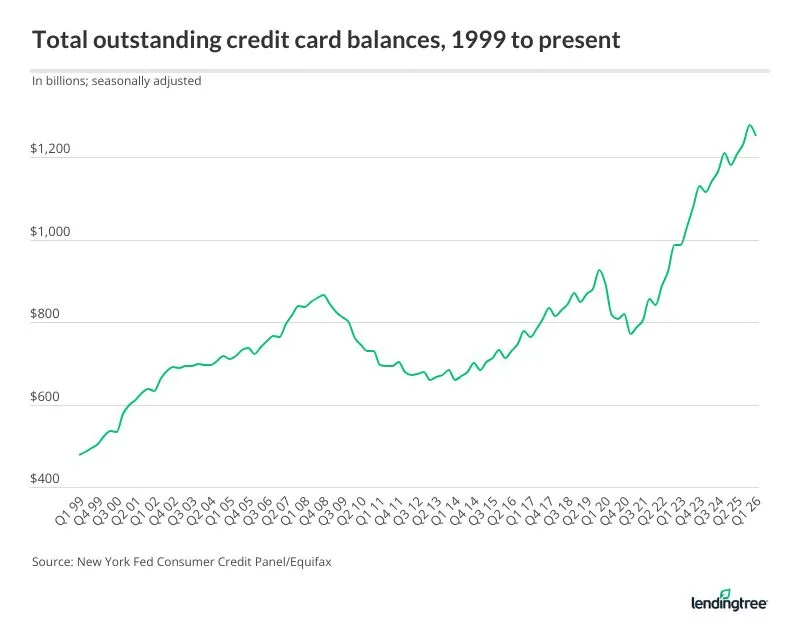
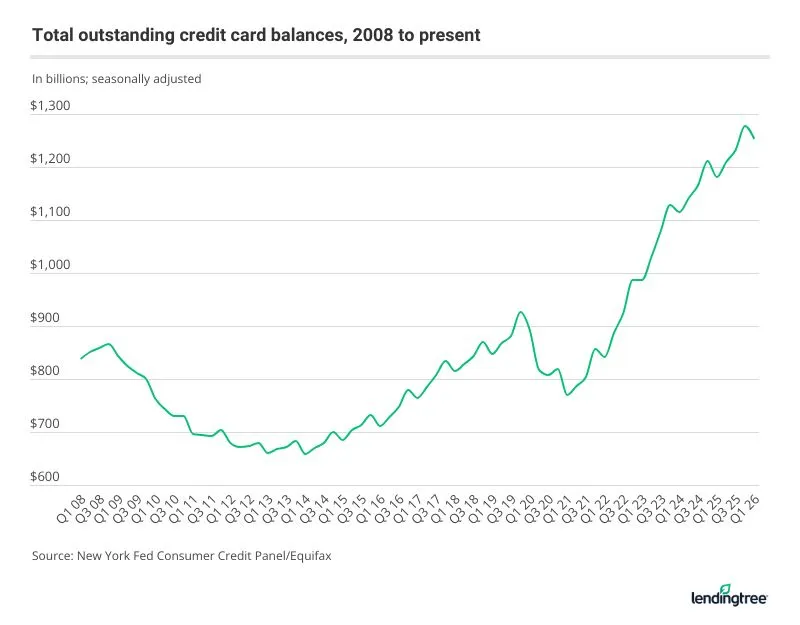
Credit card debt rose steadily until the financial crisis, then declined from $866 billion in Q4 2008 to $660 billion in Q1 2013 before resuming its upward trajectory.
Then, when the pandemic took hold in 2020, credit card balances plunged again — from $927 billion in Q4 2019 to $770 billion in Q1 2021. Balances then rebounded sharply, beginning with a significant increase in Q4 2021 and continuing to reach new highs in subsequent years.
Which states’ residents have the most credit card debt?
Credit cardholders in Connecticut have the highest average credit card debt of any state, according to LendingTree data, while those in Mississippi have the lowest.
| Rank | State | Avg. credit card debt, Q3 2025 | Avg. credit card debt, Q3 2024 | % difference, Q3 24 to Q3 25 |
|---|---|---|---|---|
| 1 | Connecticut | $9,778 | $9,323 | 4.9% |
| 2 | New Jersey | $9,748 | $9,112 | 7.0% |
| 3 | Maryland | $9,630 | $8,830 | 9.1% |
| 4 | Hawaii | $9,448 | $8,798 | 7.4% |
| 5 | District of Columbia | $9,413 | $9,209 | 2.2% |
| 6 | California | $9,396 | $9,191 | 2.2% |
| 7 | Alaska | $9,261 | $9,040 | 2.4% |
| 8 | Massachusetts | $9,244 | $8,685 | 6.4% |
| 9 | Florida | $9,184 | $9,094 | 1.0% |
| 10 | New York | $9,089 | $8,810 | 3.2% |
| 11 | Washington | $9,039 | $8,086 | 11.8% |
| 12 | Colorado | $8,911 | $8,371 | 6.5% |
| 13 | New Hampshire | $8,696 | $8,217 | 5.8% |
| 14 | Virginia | $8,416 | $8,136 | 3.4% |
| 15 | Texas | $8,394 | $8,316 | 0.9% |
| 16 | Nevada | $8,381 | $8,186 | 2.4% |
| 17 | Illinois | $8,328 | $7,846 | 6.1% |
| 18 | Arizona | $8,307 | $7,842 | 5.9% |
| 19 | Georgia | $8,090 | $7,925 | 2.1% |
| 20 | Rhode Island | $8,069 | $8,069 | 0.0% |
| 21 | Delaware | $7,787 | $7,598 | 2.5% |
| 22 | Oregon | $7,745 | $7,204 | 7.5% |
| 23 | Vermont | $7,670 | $7,478 | 2.6% |
| 24 | Utah | $7,613 | $7,290 | 4.4% |
| 25 | Maine | $7,422 | $7,026 | 5.6% |
| 26 | Montana | $7,412 | $7,106 | 4.3% |
| 27 | Minnesota | $7,339 | $6,820 | 7.6% |
| 28 | North Carolina | $7,297 | $6,940 | 5.1% |
| 29 | Idaho | $7,265 | $6,694 | 8.5% |
| 30 | South Dakota | $7,223 | $6,465 | 11.7% |
| 31 | Pennsylvania | $7,199 | $6,992 | 3.0% |
| 32 | Nebraska | $7,075 | $6,355 | 11.3% |
| 33 | Kansas | $6,979 | $6,818 | 2.4% |
| 34 | Wyoming | $6,833 | $6,873 | -0.6% |
| 35 | Michigan | $6,812 | $6,318 | 7.8% |
| 36 | North Dakota | $6,707 | $6,437 | 4.2% |
| 37 | South Carolina | $6,706 | $6,615 | 1.4% |
| 38 | Wisconsin | $6,703 | $6,082 | 10.2% |
| 39 | Ohio | $6,536 | $6,300 | 3.7% |
| 40 | Missouri | $6,421 | $6,069 | 5.8% |
| 41 | Iowa | $6,394 | $6,064 | 5.4% |
| 42 | Indiana | $6,096 | $5,876 | 3.7% |
| 43 | Oklahoma | $5,963 | $6,004 | -0.7% |
| 44 | Alabama | $5,889 | $5,765 | 2.2% |
| 45 | New Mexico | $5,871 | $6,543 | -10.3% |
| 46 | Tennessee | $5,846 | $5,727 | 2.1% |
| 47 | Louisiana | $5,421 | $5,529 | -2.0% |
| 48 | Kentucky | $5,368 | $5,266 | 1.9% |
| 49 | West Virginia | $5,336 | $5,497 | -2.9% |
| 50 | Arkansas | $5,259 | $5,305 | -0.9% |
| 51 | Mississippi | $4,887 | $4,918 | -0.6% |
LendingTree analysts reviewed anonymized credit report data from Q3 2025 for more than 400,000 LendingTree users to calculate these averages and create a list of states with the most debt. The analysis was also compared with Q3 2024 data from more than 410,000 reports.
Overall, the national average card debt among cardholders with unpaid balances in Q3 2025 was $7,886, up 2.8% from $7,673 in Q1 2024. That includes debt from bank cards and retail credit cards.
Eleven states had average balances of at least $9,000. Connecticut leads at $9,778, ahead of New Jersey ($9,748) and Maryland ($9,630).
The six states with the lowest balances are in the South. Mississippi’s balance is $4,887, lower than Arkansas ($5,259) and West Virginia ($5,336).
Washington has the fastest-growing card debt in the period analyzed. That state’s average card balance grew a troubling 11.8% from Q3 2024 to Q3 2025, rising from $8,086 to $9,039. Three other states saw double-digit increases, including South Dakota (up 11.7%), Nebraska (up 11.3%) and Wisconsin (up 10.2%).
Meanwhile, New Mexico saw the largest year-over-year decrease in debt, with its residents’ debt falling 10.3% from $6,543 to $5,871. In all, seven states saw credit card balances decrease in the past year. West Virginia (down 2.9%) and Louisiana (down 2.0%) joined New Mexico as the only states to see decreases of at least 2.0%.
What percentage of credit cardholders carry a balance?
Fewer than half of adult credit cardholders (45%) carried a balance on a credit card for at least one month in the past year, according to a May 2026 Federal Reserve study using 2025 data.
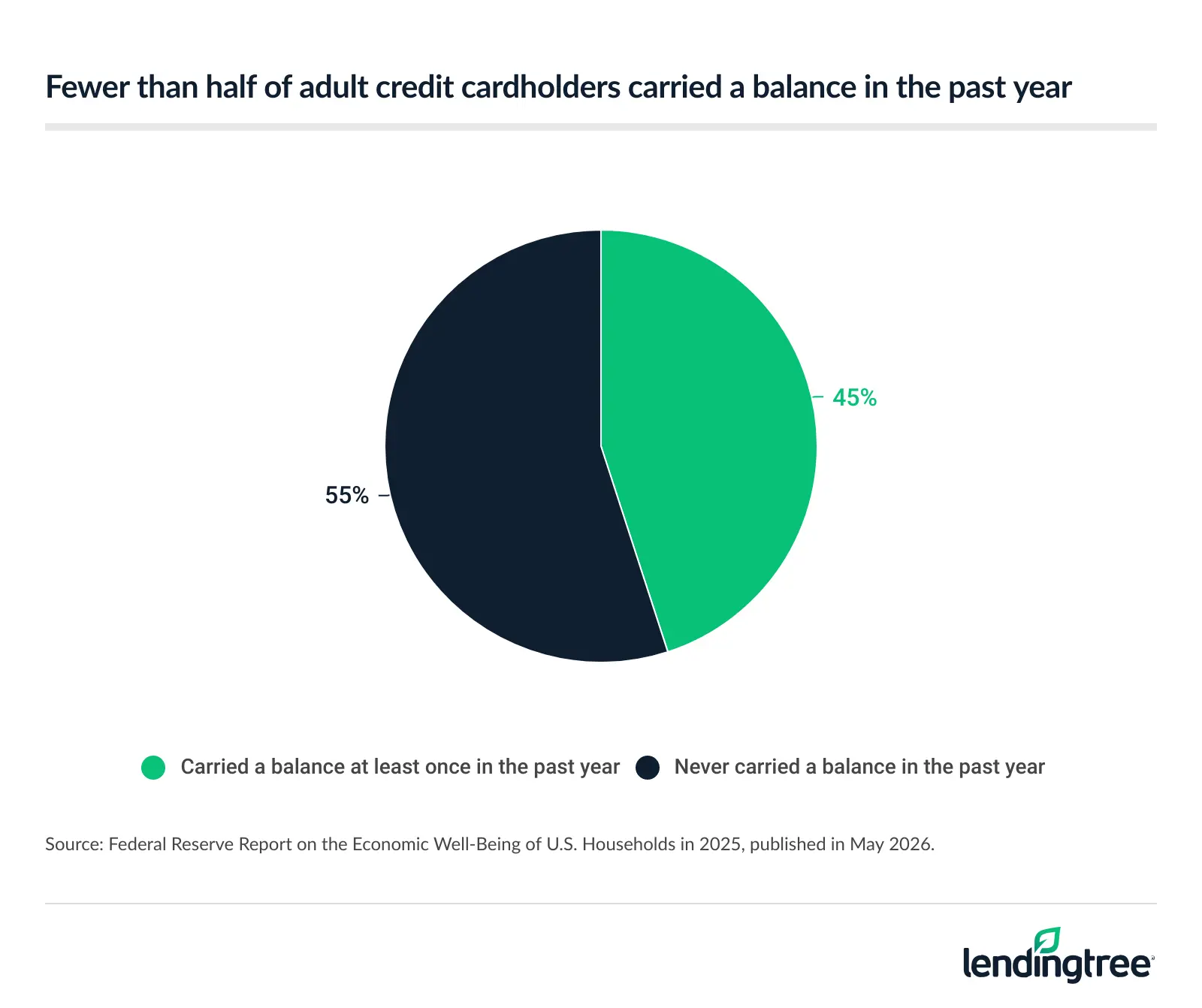
Paying a credit card balance in full each month is the most effective way to avoid interest charges and keep debt from accumulating. However, many consumers carry balances at least occasionally because of unexpected expenses, income disruptions or other financial pressures.
What’s the average interest rate on people’s credit cards? What about those who carry a balance? What about new credit card offers?
For all credit cards, the average APR in Q1 2026 was 21.00%.
For cards accruing interest, the average in Q1 2026 was 21.52%.
For new credit card offers, the average is 23.79%.
- Average APR, current card accounts: 21.00%
- Average APR, accounts that accrue interest: 21.52%
- Average APR, new credit card offers: 23.79%
The Federal Reserve’s G.19 consumer credit report showed that the average APRs for cards accruing interest fell to 21.52% in Q1 2026, down from 22.30% in Q4 2025. Meanwhile, APRs for all current credit card accounts rose slightly to 21.00% in Q1 2026 from 20.97% in Q4 2025.
Consumers opening a new credit card account may face higher rates than the averages for existing accounts. The latest LendingTree data on credit card APRs shows that the average APR with a new credit card offer is 23.79%, with the average card offering an APR range of 20.19% to 27.40%. Actual rates vary based on factors including creditworthiness.
The 23.79% average was unchanged from May. Before that, the average stood at 23.75% in April and increased slightly in May, marking the first monthly rise since September. Despite that increase, average new-card APRs remain near their lowest levels since March 2023.
The decline in average APRs followed a series of Federal Reserve rate cuts in late 2025. However, the Fed left rates unchanged at its early 2026 meetings, reducing downward pressure on credit card APRs.
Even if interest rates decline in the future, credit card APRs would likely remain elevated by historical standards.
And as the chart below shows, APRs can vary significantly by card type.
Average APRs by category
| Category | Min. APR | Max. APR | Avg. | Prior month |
|---|---|---|---|---|
| Avg. APR for all new credit card offers | 20.19% | 27.40% | 23.79% | 23.79% |
| 0% balance transfer credit cards | 17.59% | 26.78% | 22.19% | 22.20% |
| No-annual-fee credit cards | 19.65% | 26.93% | 23.29% | 23.29% |
| Rewards credit cards | 19.92% | 27.53% | 23.72% | 23.70% |
| Cash back credit cards | 20.20% | 27.45% | 23.82% | 23.81% |
| Travel rewards credit cards | 19.43% | 28.00% | 23.71% | 23.66% |
| Airline credit cards | 19.43% | 28.63% | 24.03% | 24.03% |
| Hotel credit cards | 19.39% | 28.32% | 23.86% | 23.86% |
| Low-interest credit cards | 13.30% | 21.31% | 17.31% | 17.49% |
| Grocery rewards credit cards | 19.87% | 27.75% | 23.81% | 23.75% |
| Gas rewards credit cards | 20.47% | 27.50% | 23.98% | 23.91% |
| Dining rewards credit cards | 19.36% | 27.68% | 23.52% | 23.46% |
| Student credit cards | 17.49% | 27.09% | 22.29% | 22.29% |
| Secured credit cards | 26.09% | 26.09% | 26.09% | 26.13% |
Of course, your best move is to make those interest rates a moot point by paying your card debt in full, but that’s often easier said than done.
How many Americans are currently delinquent with their credit card payments?
Just 2.94% of Americans’ outstanding credit card balances were at least 30 days delinquent in the fourth quarter of 2025.
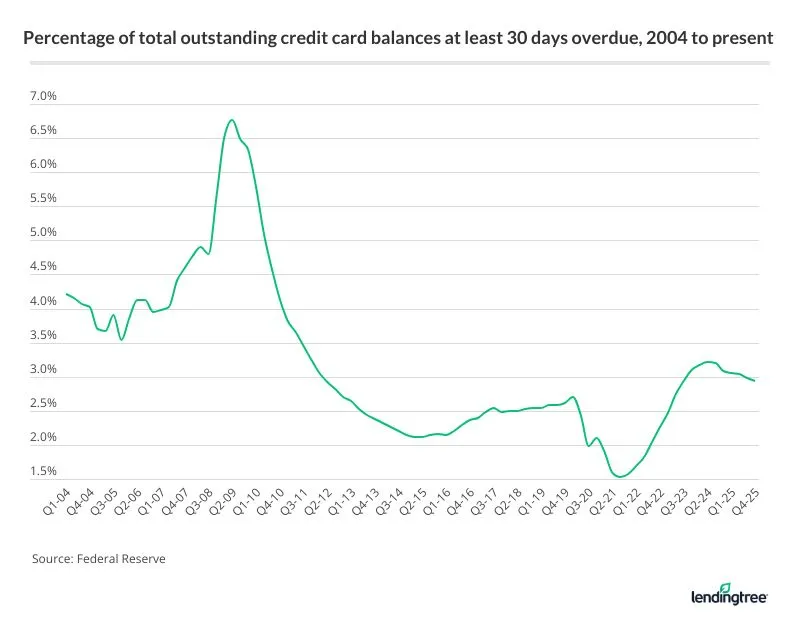
According to the most recent delinquency data from the Fed, the 30-day delinquency rate — the share of outstanding credit card balances that were at least 30 days past due — dipped to 2.94% in the fourth quarter of 2025, the sixth straight quarterly decrease.
Those declines followed a stretch of 11 consecutive quarterly increases, during which the delinquency rate climbed to its highest level since Q4 2011. However, delinquency rates are still near historic lows. The average delinquency rate since the Fed began tracking in 1991 is 3.70%, while the average since 2000 is 3.43%.
Current delinquency rates also remain well below Great Recession levels, when they peaked at nearly 7% in 2009 and stayed above 5% for almost two years.