Auto Refinancing Resources
Your guide to auto refinancing


Advertising Disclosures
Loading Disclosures…
It’s no secret: Auto loan rates are up. Car payments are up. Gas prices are up. Some car costs are out of your control, but your loan may not be. Explore refinancing options, get answers to your questions and compare loan offers — all in one place.
Explore auto refinance loan types

Auto refinance loans
Want a cheaper car payment or think you could get a better deal? LendingTree research found that borrowers who refinanced saved an estimated $1,346 in total loan costs on average.

Bad credit auto refinance loans
Yes, you can refinance a car loan with bad credit — but that doesn’t always mean you’ll get a better deal.

Cash-out auto refinance loans
You can get cash by refinancing your car loan, but it comes with risks. Learn how much you might be able to borrow and other ways to get money when you’re in a bind.
Looking to buy a car? See LendingTree’s auto loan resources.
Compare your options
Refinance or trade in?
Refinancing or trading in your current car could help you get a cheaper car payment, but each option comes with trade-offs.
Refinance now or later?
You might get a better deal by waiting for lower market rates or a better credit score, but refinancing now could save you money sooner.
Refinance or make extra payments?
You could pay off your car sooner by refinancing or making extra payments on your current loan — but one might save you more on interest.
Refinance or consolidate your auto loans?
Combining multiple car loans could make your payments easier to manage, but it won’t necessarily save you money.
Rates & market insights
are averaging:
8.49%
Based on average APRs offered to LendingTree customers seeking auto loans to refinance light trucks and cars in Q3 2026.Average auto refi rates by credit score
It’s hard to know how much you could save by refinancing without comparing refinance offers with your current loan. If you’re not ready to shop for a loan yet, use the averages below to get an idea of refinance rates for your credit score.
| Credit tier | Average APR | Average amount | Average term |
|---|---|---|---|
| Excellent (800 and above) | 5.71% | $30,409 | 66 months |
| Very good (740-799) | 5.93% | $34,594 | 66 months |
| Good (670-739) | 7.08% | $29,831 | 65 months |
| Fair (580-669) | 10.09% | $30,724 | 66 months |
| Poor (under 580) | 13.36% | $27,182 | 67 months |
Auto industry insights
- Car ownership is a financial stretch, according to nearly 40% of Americans.
- Car payments (+2.1% for new cars per Experian) and gas prices (+39%) are up year over year.
- Over 80% of Americans are changing their driving habits to afford transportation costs.
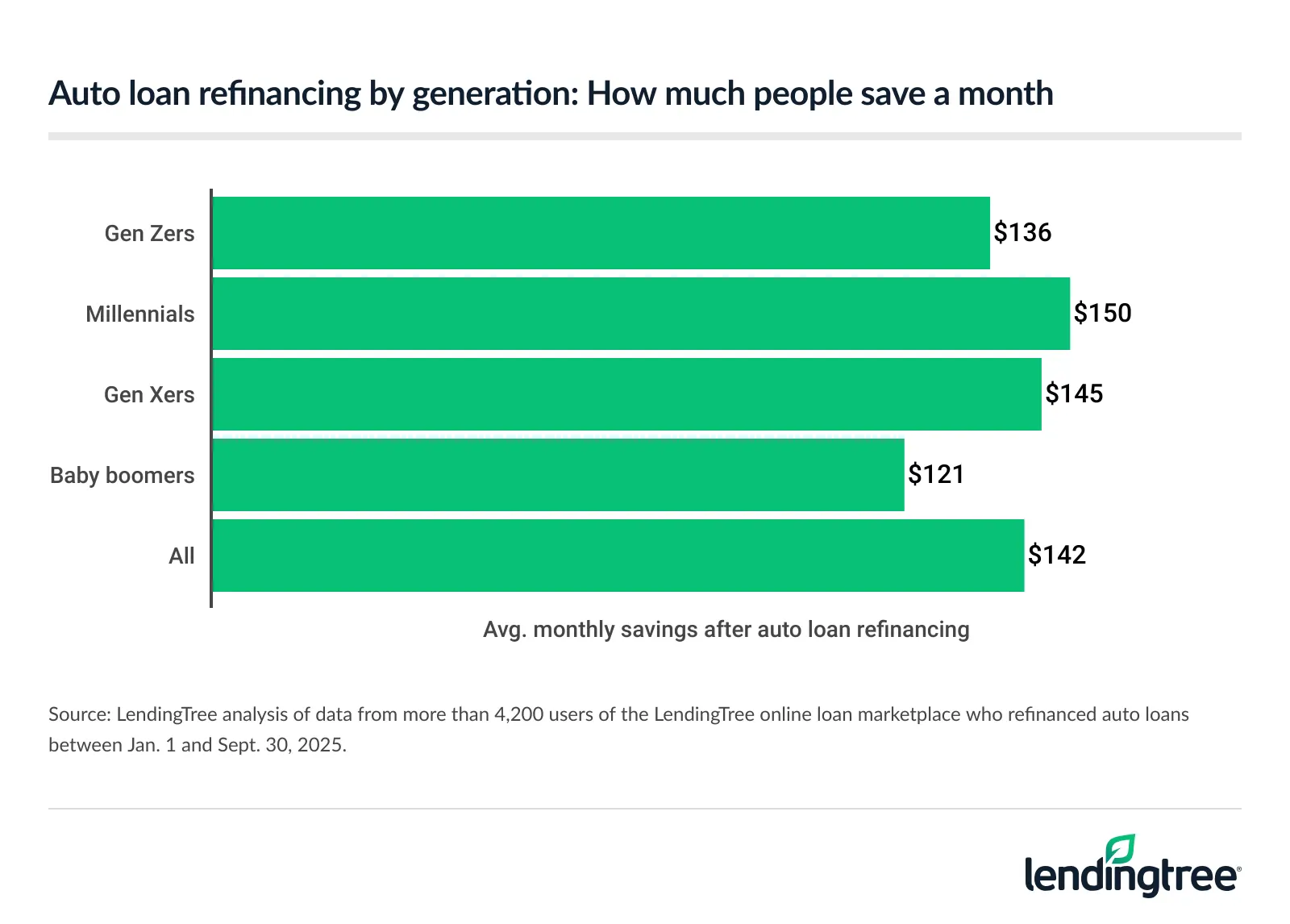
- In the face of these rising costs, people who refinance their car loan could save an average of $142 per month and $1,346 over the life of the loan.
Helpful tools & calculators
Estimate how much you could save by refinancing.
Auto lenders like to see a DTI below 35%. Calculate yours.
The higher your score, the better your rates tend to be. Check your credit score for free with the LendingTree app.
Expert guides to auto refinancing
How it works
How to refinance a car loan
We’ll walk you through refinancing your car, step by step.
How to refinance a car loan with bad credit
Bad credit can make refinancing harder, but you still have options. Here’s how to improve your chances.
How refinancing affects your credit
Refinancing can temporarily lower your credit score, but the savings might be worth it.
Your options
How soon you can refinance a car after buying
You can usually refinance as soon as your paperwork is processed, but it’s often smarter to wait.
Refinancing to remove a cosigner
Lenders often won’t let your cosigner off the hook unless you refinance. Learn what it takes to qualify on your own.
Refinancing with the same lender
See when it makes sense to refinance with the same lender — and whether it’s possible for you.
How to lower your car payment
Explore other ways to get a cheaper payment.
Getting out of your loan
How to get out of a car loan you can’t afford
Can’t afford your car payments anymore? Refinancing isn’t your only option for getting out of a loan.
Transferring a car loan to someone else
Most lenders won’t let you transfer a car loan, but someone else may be able to take over the debt with a new loan.
Can you refinance a car with negative equity?
Refinancing an upside-down car loan is possible, but finding a lender can be harder — and it may cost you more.
Reviews & best providers
Learn more about how we pick the best auto refi loan lenders.
Ready to compare?
See auto refinancing offers with LendingTree
You’d shop around for flights. Why not your loan? LendingTree makes it easy. Instead of applying to one lender and hoping for a good rate, you can see multiple lenders compete for your business — so you can choose the best offer.
1. Tell us what you need
Take two minutes to tell us what you need to refinance. We’ll take care of the rest. It’s free, simple and secure.
2. Shop your offers
LendingTree users get at least three auto loan refi offers on average, even if they have bad credit. Compare your offers side by side to get the best deal.
3. Get refinanced
Choose an offer, finalize your loan and you could have the money you need in as soon as 24 hours.
Frequently asked questions
There’s no universal minimum credit score to refinance, but you’ll likely get better rates and more offers with a good credit score (670 or higher). See how many auto refi offers LendingTree users get by credit score.
Refinancing can come with lender fees, title transfer fees and other state-specific costs. Some fees may be rolled into your new loan, while others must be paid upfront. Your current lender may also charge a prepayment penalty.
You can get auto refi offers as soon as the same day, but the entire process may take a week or two, sometimes longer. You’ll need to review offers, provide documents, sign paperwork and wait for your old loan to be paid off.
You’ll typically need many of the same documents required for a car loan: proof of identity, residence, income, insurance and vehicle information. You’ll also need details about your current lender and loan.